
Posted by Electric Solenoid Valves on Nov 12th 2026
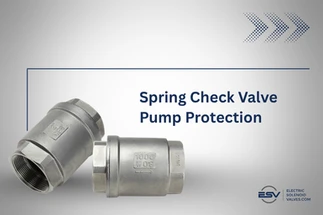
Spring Check Valve Pump Protection
Stainless Steel Spring Check Valves for Pump Protection: Stopping Water Hammer & Mechanical Failure
In industrial piping and commercial booster skids, pump discharge lines are subject to rapid flow reversal, severe hydraulic shock (water hammer), and premature mechanical wear. Protecting costly pumps takes more than a basic backflow preventer. It calls for an inline, rapid-closing check valve built to withstand dynamic pressure transients and process fluids.
While swing check valves are common in general utility mains, 304 stainless steel spring check valves are often the preferred choice for direct pump protection, vertical risers, and parallel pumping manifolds.
How Unprotected Pumps Fail: The Three Core Hazards
- Hydraulic Water Hammer: When a pump shuts down, fluid momentum collapses and reverses almost instantaneously. Slow-closing swing check valves wait for reverse flow to slam the disc shut, creating a pressure wave that can stress valve bodies, loosen pipe joints, and damage pump components.
- Reverse Impeller Spin in Parallel Skids: In multi-pump booster arrays, an active pump can drive high-pressure fluid back through an idle parallel pump if the check valve fails to seal immediately. Reverse spinning can stress pump shafts, damage drive couplings, and strain the motor on restart.
- Corrosive & High-Thermal Degradation: Standard cast iron or brass check valves can pit, dezincify, or scale when exposed to treated water, deionized loops, chemicals, or steam condensate.
Why Spring Check Valves Support Pump Protection
- Pre-Emptive Closure (Anti-Water Hammer): Internal spring tension starts closing the valve as forward flow slows, before significant flow reversal occurs. By seating early, spring check valves help reduce water hammer and shock-induced pipe vibration.
- Orientation Independence: Unlike swing checks that require horizontal installation (or bottom-to-top vertical flow) to utilize gravity, spring-assisted mechanisms operate reliably in vertical upward, vertical downward, or horizontal orientations.
- Tight Sealing Across Rated Pressures: Rated up to 1,000 PSI (800 PSI for 3" models) and handling temperatures from -4°F to 356°F, 304 stainless steel construction with PTFE seals provides reliable shutoff for water, air, fuel, and other compatible media. Always confirm chemical compatibility before use.
Technical Comparison Matrix: Pump Protection Performance
| Application Parameter | Stainless Steel Spring Check | Stainless Steel Swing Check |
|---|---|---|
| Available Sizes (NPT) | 1/4" to 3" NPT | 1/2" to 2" NPT |
| Max Pressure Rating | Up to 1,000 PSI (800 PSI for 3") | 200 PSI |
| Response Speed | Fast (Spring-Assisted Pre-Closure) | Slow (Flow Reversal/Gravity Dependent) |
| Water Hammer Prevention | Strong (Helps Reduce Hydraulic Surge) | Limited (More Prone to Valve Slamming) |
| Vertical Downward/Upward Flow | Fully Compatible | Horizontal Primary (Vertical Bottom-Up Only) |
| Parallel Pump Protection | Fast Sealing (Helps Prevent Reverse Spin) | Slower Closure (Higher Backflow Risk) |
| Media Capability | Clean Water, Air, Fuel, Other Compatible Fluids | Water, Air, Fuel (Better Tolerance for Suspended Solids) |
Sizing & Engineering Best Practices for Pump Skids
- Verify Cracking Pressure: Spring check valves require sufficient forward pressure to overcome internal spring tension (cracking pressure) and open fully. Ensure minimum pump discharge pressure comfortably exceeds the cracking threshold to prevent valve chatter and premature wear.
- Size by Flow Capacity (Cv), Not Pipe Size Alone: Never size a check valve strictly by line thread size. Calculate required flow capacity using the valve's Cv rating (ask our team if it is not listed) to avoid excessive pressure drop across the pump skid.
- Match Media Compatibility: Confirm your media is compatible with 304 stainless steel and PTFE seals using our chemical compatibility database. For slurries or heavy suspended solids, a swing check valve is usually the better fit, since debris can clog the spring mechanism.
Got Questions? Talk to a Valve Expert Today
Selecting the right check valve depends on your media type (water, air, gas, steam, or chemicals), operating pressure, flow capacity (Cv), cracking pressure, and mounting orientation. Whether you are replacing a failed valve, specifying components for an OEM pump skid, or engineering a commercial fluid system, our technical team can help you select the exact solution for your application.
If you have questions or need sizing assistance, email us at sales@electricsolenoidvalves.com or call 800-983-8230 (Monday through Friday, 9:00 AM to 5:00 PM EST). Our team is ready to help with selection, troubleshooting, and custom setups.