
Posted by Electric Solenoid Valves on Aug 6th 2026
2-Wire vs. 3-Wire Electric Ball Valve Actuators: Key Differences & Selection Guide
2-Wire vs. 3-Wire Electric Ball Valve Actuators: Key Differences & Selection Guide
Imagine that during a facility-wide power outage, a chemical dosing valve remains open because the actuator was designed to stay in its last position. Instead of automatically isolating, operators must intervene before the system can be safely restarted. The valve isn't faulty—the actuator is simply operating exactly as it was designed to.
If you have spent any time comparing electric ball valves, you’ve probably come across actuators described as either “2-wire” or “3-wire”. At first glance, it seems like a wiring detail that only matters to the electrician installing the valve. However, the difference goes much deeper than the number of wires coming out of the actuator.
The actuator determines how the valve behaves, how it integrates with your control system, and perhaps most importantly, what happens when power is lost. There are situations where incorrect actuators are selected simply because it was assumed that all electric ball valves operate the same way. Everything looked fine on paper until the first power interruption occurred.
2-Wire vs. 3-Wire Electric Ball Valve Actuators
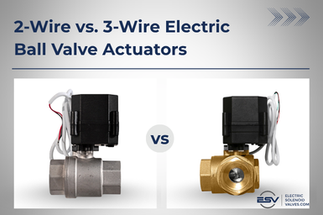
The most common designs are the 2-wire spring return actuators and 3-wire motorized actuators. While both accomplish the same task, they do it in very different ways.
What is a 2-Wire Electric Ball Valve Actuator?
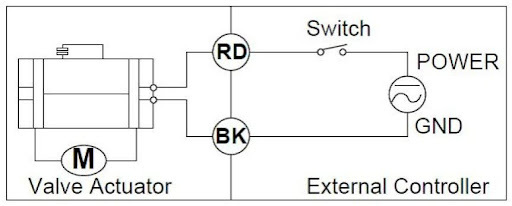
Most 2-wire electric ball valve actuators are designed to automatically return to a predetermined fail-safe position when power is removed. Depending on the manufacturer, these actuators may be referred to as auto-return, fail-safe, or capacitor-assisted return actuators. Atlantic Valve's 2-wire actuators use a capacitor-assisted return mechanism rather than a mechanical spring. An internal capacitor stores energy during normal operation and powers the actuator back to its fail-safe position during a power loss. Because the return is motor-driven rather than spring-driven, the actuator provides controlled, consistent movement while eliminating the need for a mechanical return spring.
The concept is simple: when power is applied, the motor drives the valve open, and when power is removed, an internal spring returns the valve to its normal position, which is typically closed.
Think of it almost like a door closer on a commercial building. You can push the door open, but once you let go, the spring returns it. The actuator works in much the same way.
- Power → Opens the Valve
- Power Loss → Closes the Valve
For many applications, this is exactly what users want.
Why Some Engineers Prefer 2-Wire Actuators
The biggest advantage is predictability. If power disappears, the valve moves to a known position. There is no decision to make and no additional control signal required.
For example, imagine a chemical feed line supplying a treatment system. If power is interrupted, most operators would rather have the valve close automatically than remain open indefinitely.
Another benefit is wiring simplicity. Many control systems only need to energize or de-energize a relay. This makes integration relatively straightforward. You don’t need separate open and close commands. The actuator handles the return movement on its own.
Applications That Typically Favor 2-Wire Actuators
A 2-wire actuator is often the preferred choice when safety and predictable shutdown behavior are important.
Common examples include:
- Energy shutoff systems
- Chemical isolation valves
- Leak detection systems
- Fuel Transfer systems
- Equipment protection circuits
In these applications, losing power should trigger a known response. The spring return design makes that happen automatically.
The Trade-Off
Of course, every design comes with a compromise. A 2-wire actuator cannot stay open when power is removed. This may sound obvious, but it’s worth thinking about before making a selection. In some systems, automatic closure is desirable. In others, it can create operational problems.
That’s where 3-wire actuators enter the conversation.
What is a 3-Wire Electric Ball Valve Actuator?
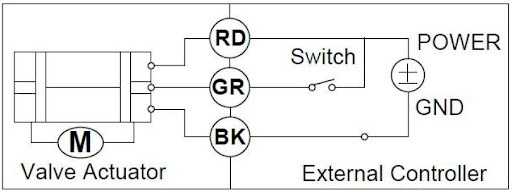
A 3-wire actuator takes on a different approach.
Instead of using a spring to return the valve, the motor drives the valve both open and closed. One signal opens the valve, and a second control signal closes the valve. Once the valve reaches its end position, internal limit switches stop the motor automatically.
Think of it like a wall light switch. You flip it on, and it stays on until someone flips it off. If the building loses power, the switch doesn't move—it remains exactly where it was. A 3-wire actuator behaves in much the same way. It only changes position when it receives an open or close command.
The key difference is what happens when power is lost. Nothing. The valve simply remains where it was.
- If the valve was fully open before the outage, it stays open.
- If it is fully closed, it stays closed.
- If power is lost while the valve is mid-travel, it stops and holds that position. That keeps on off and modulating to prevent getting mixed up, which is a frequent cause of wrong orders.
This characteristic makes the 3-wire actuators attractive for many automation systems where maintaining the current operating state is more important than automatically returning to a fail-safe position.
Applications That Typically Favor 3-Wire Actuators
A 3-Wire Actuator is often preferred when process continuity matters more than automatic return.
Common examples include:
- Manufacturing equipment
- Water treatment processes
- Automated machinery
- Tank filling systems
- OEM equipment
- Process automation skids
- Building automation systems
These applications often benefit from maintaining valve position during temporary power interruptions.
A Common Misconception About 3-Wire Actuators
One thing worth mentioning is that people sometimes assume a 3-wire actuator is automatically a more advanced option because it has additional wiring.
A 3-wire actuator isn’t necessarily better than a 2-wire actuator. It is simply designed around a different operating principle.
How PLCs Fit Into the Picture
PLC compatibility is another area that buyers often have questions about. Both actuator types can be controlled by PLCs. The difference lies in how the PLC interacts with them.
- A 2-wire actuator usually requires only a simple switched output. Energize the circuit, and the valve opens. Remove power, and the valve returns.
- A 3-wire actuator typically uses separate open and close commands. This gives the PLC more flexibility because it can independently decide which direction the valve should move.
2-Wire and 3-Wire Ball Valve Actuator Comparison
|
Feature |
2-Wire Spring Return |
3-Wire Motorized |
|
Wiring Compatibility |
Simple |
Moderate |
|
Automatic Return |
Yes |
No |
|
Fail-Safe Operation |
Yes |
No |
|
Position Retention During Power Loss |
No |
Yes |
|
Powered Opening |
Yes |
Yes |
|
Powered Closing |
Spring Return / Capacitor Assisted |
Yes |
|
PLC Compatibility |
Good |
Excellent |
|
Relay Compatibility |
Excellent |
Good |
|
Emergency Shutdown Application |
Excellent |
Limited |
|
Process Control Applications |
Good |
Excellent |
Which Actuators Should You Choose?
There isn’t a universal answer because every system has different priorities.
|
2-Wire Spring Return |
3-Wire Motorized |
|
Fail-safe operation is required |
The valve should maintain its position during outages |
|
The valve should automatically close during a power loss |
Separate open and close commands are needed |
|
Simple wiring is preferred |
PLC integration is a priority |
|
Safety is the primary concern |
Process continuation is important |
|
Emergency shutdown capability is important |
Greater control flexibility is required |
Final Thoughts
Understanding the difference between 2-wire and 3-wire electric ball valve actuators is about much more than counting wires.
A 2-wire spring -return actuator provides fail-safe operation and automatic return during power loss. A 3-wire motorized actuator offers independent open and close control while maintaining position during outages.
Neither design is inherently better. Each was developed to solve different control challenges.
Before selecting an actuator, consider your control system, safety requirements, and expected behavior during a power failure.
Looking for the Right Actuator for your Application?
For fail-safe operation and automatic shutdown protection:
For fully powered open and close control that holds its position during a power loss:
Need help selecting the right actuator type?
Contact our team for application guidance, valve selection, and control system recommendations. Or call (800) 983-8230 or email Sales@ElectricSolenoidValves.com to speak with a valve specialist.